Roof
A wooden box covered in galvanised steel. It overhangs each side by two and a half centimetres, so rain drips well clear of the walls. Under the metal, the wood insulates against summer heat and winter cold.

Dadant-Blatt · ten frames
Our bees live in ten-frame Dadant-Blatt hives. This page explains why we chose them, what one looks like inside and how it changes from one season to the next.
Choosing the hive
There are plenty of hive designs. We chose this one for four practical reasons, and they have more to do with the honey and the bees than with us.
The honey super is shallow and separate from the brood box. We put it on when a bloom starts and take it off when it ends, so sulla, acacia and wildflower stay three distinct honeys instead of blending into one.
Ten brood frames leave room for a ligustica queen, who lays a lot, and for the honey stores a colony at 650 metres needs to reach spring.
The varroa floor has a tray that slides out from the back. We count the fallen mites without disturbing the colony and decide whether to treat based on that number.
It is the most widely used hive in Italy. Frames, supers and tools fit those of any beekeeper or supplier, so if a part breaks we can always replace it.
Up close
A Dadant-Blatt hive rebuilt in 3D to its real measurements. Turn it, zoom in and take it apart one piece at a time, down to the brood comb.
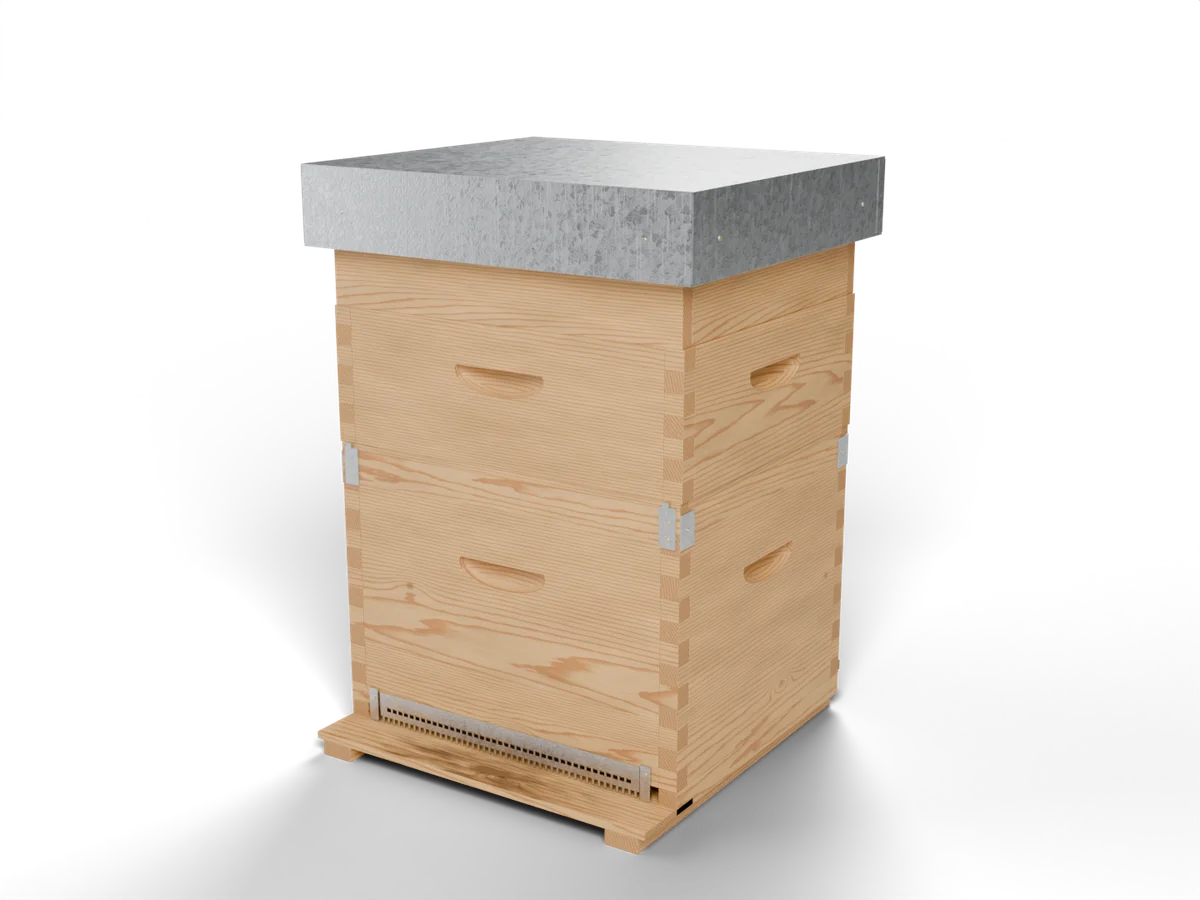
Your browser can't show the 3D model.
Choose a piece, or tap it on the hive, to take it apart and see what it does.
A wooden box covered in galvanised steel. It overhangs each side by two and a half centimetres, so rain drips well clear of the walls. Under the metal, the wood insulates against summer heat and winter cold.
It closes the hive under the roof and leaves the bees the right gap above the frames. The hole in the middle takes a feeder: in autumn, if stores are low, that is where we give syrup or fondant.
The honey floor. It is 175 millimetres tall and holds nine frames, spaced wider than in the brood box, so the bees draw the cells out longer and fill them with honey. We add it in spring, when the colony is strong, and take it off at harvest.
Once the honey is ripe, at roughly 18% water or less, the bees seal every cell with a wax lid called a capping. At harvest we lift the cappings with an uncapping fork and spin the honey out in an extractor.
A steel grid between the brood box and the super, with slots just over 4 millimetres wide. Workers fit through, the queen doesn't, because she is bigger. So she can't lay eggs in the super, and its combs hold only honey.
The queen and the brood live here. We never take honey from these ten frames: the stores left here carry the colony through the winter.
Capped brood sits in the middle: future bees sealed in their cells. Around it are larvae and, further out, freshly laid eggs. Then a ring of pollen in many colours, and an arc of honey along the top. In spring the queen lays up to about two thousand eggs a day.
The way in. The teeth let bees through but keep out mice, which look for a warm place in winter. Narrowing it helps a weak colony fight off bees that come to steal honey.
The floor is a steel mesh. Varroa, a mite that lives on bees, sometimes drops off: it falls through the mesh and can't climb back. The mesh also lets air in, which helps in summer.
It slides out from the back without opening the hive. After a few days we count the mites that have fallen and see how heavily the colony is infested, and whether it is time to treat.
We rebuilt it in 3D from the measurements of a real hive. The brood comb and the super comb are made cell by cell.
A year in the hive
The hive changes shape through the year: it gets taller in spring and shorter in autumn. Each season brings back a piece you have just taken apart.
What remains is the brood box, with the stores we left for the bees. They huddle in a cluster around the queen and we keep the hive closed: if something is wrong, the sensor tells us. When there is no brood, we treat for varroa with oxalic acid.
The queen starts laying again and the colony grows fast. Once the brood box is full we add the queen excluder and the first super on top: from there up, there will only be honey.
Each bloom gets its own super. When the combs are capped and the hive weighs more than the reserve the colony needs, we take it off and extract the honey cold.
With the supers off, the hive is back to the brood box. We check the stores and, with the tray, how many mites are falling. If there is not enough honey for winter, a feeder goes on the inner cover.
Priscilla hive · 3Bee sensor
In the Priscilla hive a sensor measures weight, temperature and humidity every day. Those numbers tell us when to take a super off. A full year of readings is published.